

We all change our minds. It’s part of evolving as human beings.
And when it comes to political issues, we usually have some help. There’s virtually always an active effort to nudge, even yank, public sentiment in one direction or another.
Americans, for instance, didn’t wake up one day and support gay couples getting married.
It took a couple of decades of constant work to persuade the country it was the right thing to do. Fairness under the law.
Over time, polls jumped an astounding 20 points.
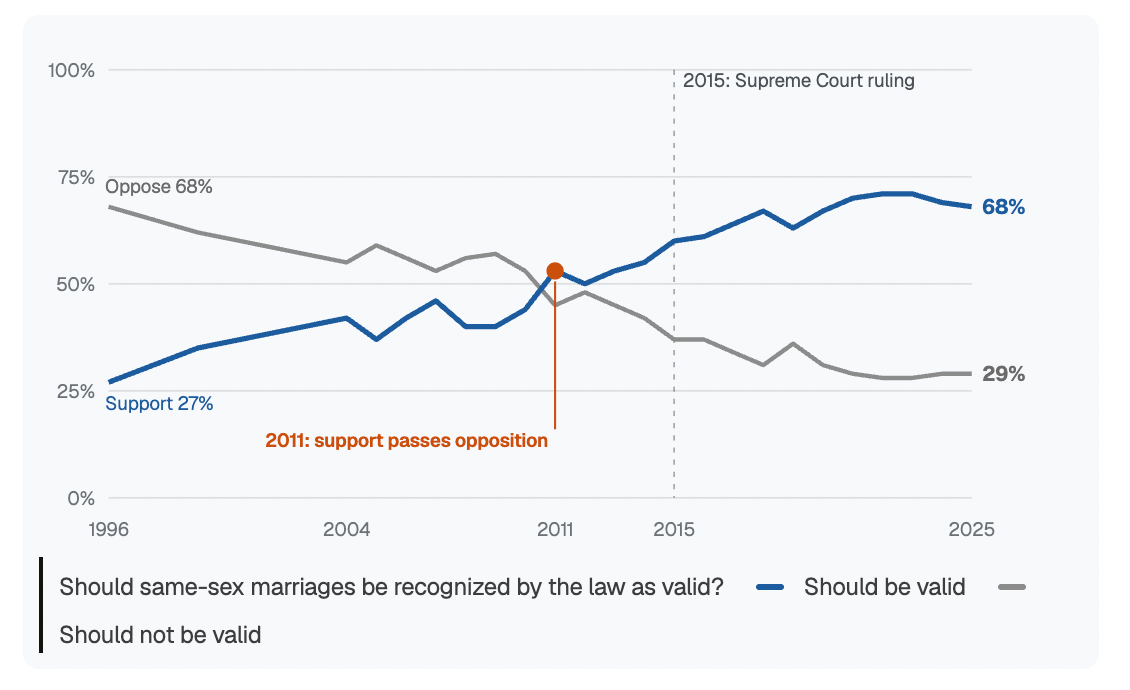
Such supermajority support showed the country was on board. Public approval was the driver that led to 36 states legalizing gay marriage before the U.S. Supreme Court made it the law of the land in 2015.
The political wedge lost its edge. Even among Republicans.
Since then, support for marriage equality has only been increasing. In these partisan times, that’s impressive.
Back in 2015, I told The Washington Post,“It’s refreshing that, for once, the [marriage] work is over, and it’s going to stay over.”
But I was wrong.
There are initial signs that some on the far right, long opposed to same-sex marriage, have been hard at work.
Support among Republicans has slipped in the past couple of years.
Lundry urges caution on how to read the GOP number.
Where the far right has been successful in moving the needle
Here are three issue areas where the far right has gained traction when it comes to persuading people to believe something. It doesn’t matter if it’s true or not.
The point is how powerful persuasion, done properly, is.
Note: I’m not talking about a change in policy in all cases. I’m talking about a change in a sizeable portion of what Americans believe — or tell pollsters they believe.
On Election Integrity
There should be no doubt that the U.S. election system is secure, free, and fair.
Intelligence officials and Republican lawmakers have studied the issue to death. Over six years they’ve come up with nothing.
Most Americans don’t believe the lie that the 2020 presidential election was stolen, but a striking number do.
MAGA politicians have successfully raised doubts about election integrity.
It is one of the most successful campaigns to move public opinion from zero people believing something to millions.
On Immigration
Legal and undocumented immigration is one of MAGA’s winning issues; they’ve been taking a hard line against immigrants for 10 years.
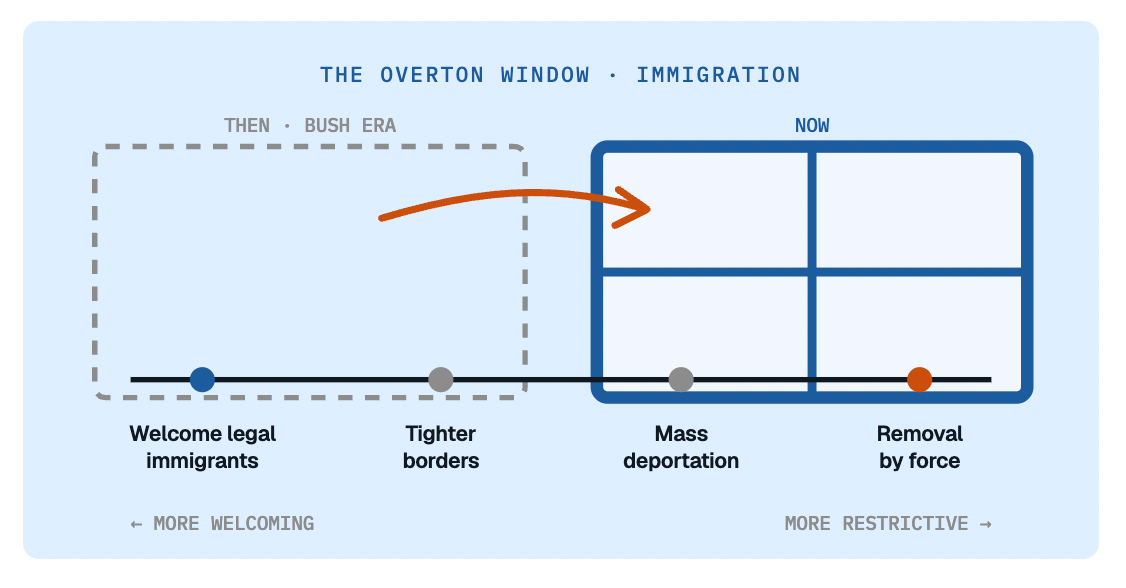
They have successfully moved the Overton Window from George W. Bush’s compassionate conservatism that welcomed immigrants who follow the process legally to tossing them out of the country, often with force.
Overton Window: the range of policies and ideas the mainstream public considers acceptable at a given time. It is named for Joseph P. Overton of the Mackinac Center for Public Policy.
Meanwhile, Democrats have avoided the issue, hoping it would go away, or splintered off into different policy directions and no message.
On Vaccines
The campaign against science and scientists isn’t new. But in recent years the anti-vaxxer political movement has grown, shifting a larger slice of public opinion against vaccines.
The percentage of Americans who believed childhood vaccinations were important plummeted by 18 points in five years — from 2019 to 2024.
Share saying it is “extremely important” for parents to vaccinate their children: 58% in 2019, 40% in 2024. (Gallup, Aug. 7, 2024)
Moving Forward
The question moving forward is: Can the other side of these and other policy issues get a footing?
The answer is yes. Narratives are almost always changeable, if not reversible.
A new narrative can knock the old one off the radar if there’s enough sustained messaging and media amplification.
As parts of the conservative legal establishment continue to challenge marriage at the U.S. Supreme Court and at the state level, those who believe in freedom, fairness, and family would be wise to restart their marriage machine when the political climate becomes more favorable.